Agentic AI Workflow Automation Explained: What UK Ops Teams Need to Know Before They Buy (2026)
What "Agentic" Actually Changes
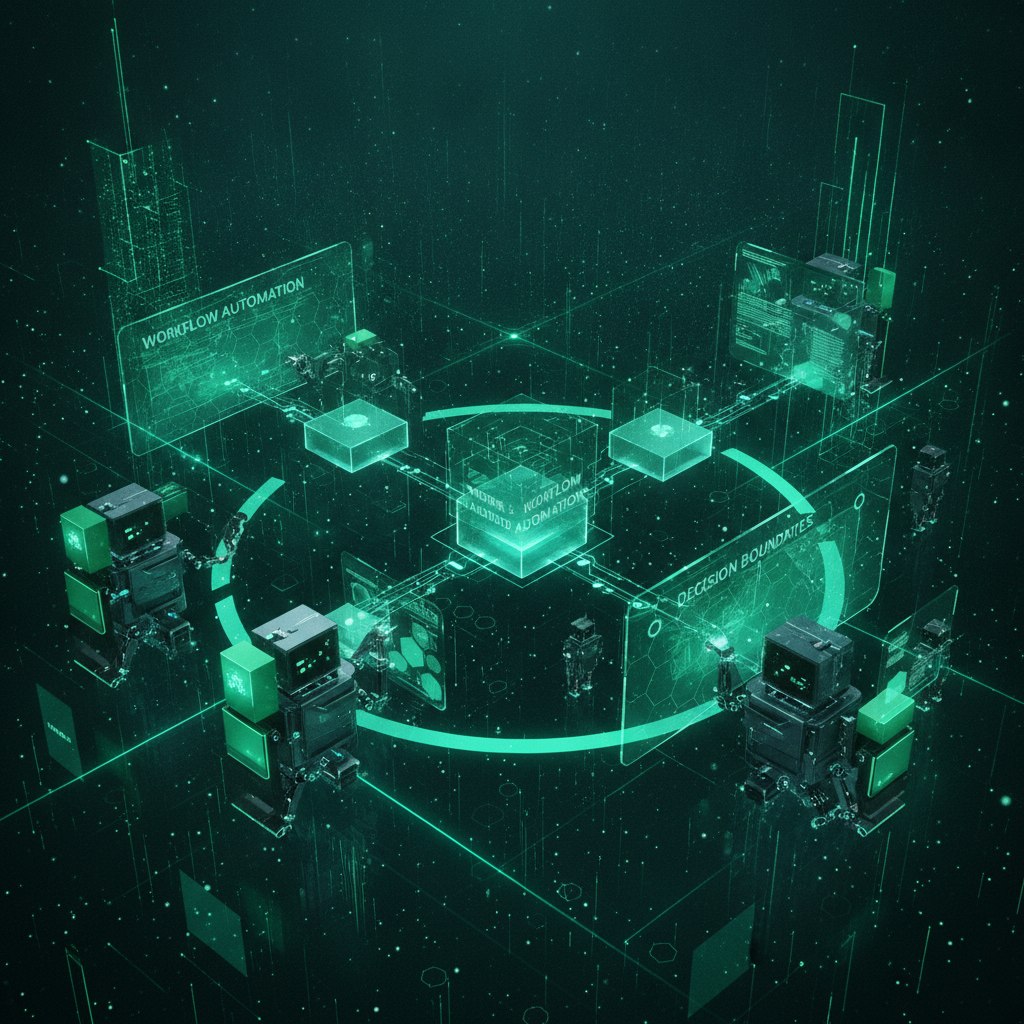
We build autonomous AI agents, not generic workflow tools — so when UK operations teams ask us to explain agentic AI workflow automation, we start with what it is not: it is not a rebrand of the Zapier-style automation you may already run. Standard workflow automation moves data along a path someone predefined in advance — when X happens, do Y. It is fast and cheap, and it works perfectly until an input arrives that nobody anticipated, at which point it stops and a human has to step in. Agentic AI workflow automation removes that stopping point. The agent reads the actual input — an email, a document, a support ticket, a partial order — reasons about what it actually means, decides the next step itself, and only escalates what genuinely needs a person.
The distinction matters commercially, not just technically: teams that buy "agentic ai workflow automation services" expecting a faster version of their existing Zapier flows are often disappointed, because the value of an agentic system shows up specifically in the exceptions a fixed workflow could never handle — not in the happy-path steps that were already automatable.
Where Agentic AI Workflow Automation Earns Its Cost
Agentic automation pays for itself where volume meets variability — a process that runs many times a week but is never quite identical twice, and where today a person has to read before anything can happen. Document intake with inconsistent formats, customer support triage that needs real judgement about intent, and lead qualification from unstructured enquiry text are typical examples. If your process is high-volume and identical every single time, you do not need an agent — you need well-built deterministic automation, and any honest agentic ai workflow automation provider should tell you that rather than sell you the more expensive option.
How Agentic AI Workflow Automation Services Should Be Structured
A properly run agentic engagement follows a specific sequence, not a demo-first sales process:
- Boundary workshop before any build. What the agent may decide alone, what it drafts for human approval, and what it must never touch — agreed in writing before a line of integration code is written.
- Process deep-dive with real historical cases. Actual emails, actual documents, actual edge cases from recent months — not an idealised flowchart of how the process is supposed to work.
- Build with permission-scoped access. The agent can only call the specific systems and actions it was explicitly granted, never a general-purpose credential.
- Red-teaming before production. Deliberately adversarial and malformed inputs, run against the agent before it ever touches live data.
- Supervised rollout with a visible audit trail. Every decision logged and reversible, with autonomy widened only as the evidence justifies it.
Our agentic workflow automation service is built around exactly this sequence for UK operations teams, and our guide to what AI agent development services include and cost breaks down realistic 2026 pricing bands by risk profile.
Questions to Ask Before You Buy Agentic Automation Services
Because "agentic" has become a popular label without a consistent standard behind it, ask any provider: can you show a written decision-boundary example from a comparable client, how do you red-team before launch, and what does the audit trail actually look like once the agent is live? A provider that cannot answer specifically is likely selling a workflow tool with an agentic label attached, not agentic AI workflow automation.
Frequently Asked Questions
Is agentic AI workflow automation the same as robotic process automation (RPA)?
No. RPA scripts a fixed sequence of UI or API actions and breaks when the input deviates from what was scripted. Agentic AI workflow automation reasons about the input first, so it can handle variation and genuine exceptions that would stop an RPA script entirely.
Do agentic ai workflow automation services replace our existing automation tools?
Usually not — they sit on top of what already works. Most engagements keep the deterministic automation for the high-volume, identical-every-time steps and add an agentic layer specifically for the judgement-heavy exceptions that were previously routed to a person.
How long does it take to get an agentic workflow into production?
A single bounded agent typically takes two to four weeks from the boundary workshop to a supervised live rollout. Multi-step agent programmes across several systems run longer, largely driven by how much historical case data is available for the replay and red-team phases.
What's the biggest risk with agentic AI workflow automation?
An agent given a decision boundary that is too wide, without adequate red-teaming or audit visibility. The risk is not the technology itself — reasoning models are reliable enough for bounded operational work — it is skipping the boundary design and testing steps that keep an agent inside the scope you actually intended.
Not sure whether your process needs an agent or a simpler automation? Book a free AI agent readiness assessment and we'll give you an honest answer either way.
 Agentic Workflow Automation
 Sales & CRM Agents
 Lifecycle & Outreach Agents