What Is AI Automation? A Plain-English Guide for Business Leaders
Let's Start by Cutting Through the Jargon
If you've sat through a technology conference in the last two years, you've heard "AI automation" more times than you can count. Vendors use it to describe everything from a basic email trigger to a complex multi-model inference system. That's not helpful. Before you can make good decisions about automation, you need a clear mental model of what it actually is.
Here's the plain-English version: AI automation is the combination of artificial intelligence — specifically, machine learning and large language models — with workflow automation technology, to create systems that can handle tasks that previously required human judgement, not just human time.
The Difference Between Automation and AI Automation
Automation, in the traditional sense, means getting computers to follow instructions so humans don't have to. "Every morning at 8am, send this email." "When a new row is added to this spreadsheet, update this database." These are simple conditional instructions — if this, then that.
Traditional automation is powerful and valuable, but it has a fundamental limitation: it can only handle situations that have been explicitly anticipated and programmed. If the email arrives in a format the system wasn't expecting, or the database field has an unexpected value, the automation fails.
AI automation adds a layer of intelligence that can handle variability. Instead of rigid rules, you have systems that can:
- Understand what a customer email is asking, regardless of how it's phrased
- Extract information from a document even if the layout varies
- Decide which category a support query belongs in based on context, not keywords
- Generate a personalised email response based on what's known about the recipient
- Detect that a customer seems frustrated and escalate them to a human agent
The AI doesn't replace the automation — it enhances it. The workflow infrastructure handles the orchestration (moving data, triggering actions, sending notifications), while the AI handles the parts that require understanding or judgement.
The Technologies Behind AI Automation
You don't need to understand the technical details to use AI automation effectively, but having a rough map helps:
Large Language Models (LLMs)
Models like GPT-4o, Claude, and Gemini can understand and generate natural language at a level that was science fiction five years ago. They're what powers AI chatbots, document extraction, email drafting, and natural language query routing. They're accessed via APIs — meaning you can add this intelligence to any workflow without building or hosting the model yourself.
Workflow Automation Platforms
Tools like Make (formerly Integromat), n8n, and Zapier provide the infrastructure for connecting different software systems and building multi-step automated workflows. They're the plumbing. AI adds the intelligence on top.
Specialised AI Tools
Beyond general LLMs, there are AI tools optimised for specific tasks — computer vision for processing images, speech-to-text for transcribing calls, optical character recognition for extracting data from scanned documents. These can be combined with workflow automation to handle processes that involve non-text inputs.
What AI Automation Can Realistically Do for a Business Like Yours
Here are concrete examples across common business functions:
Sales and Marketing
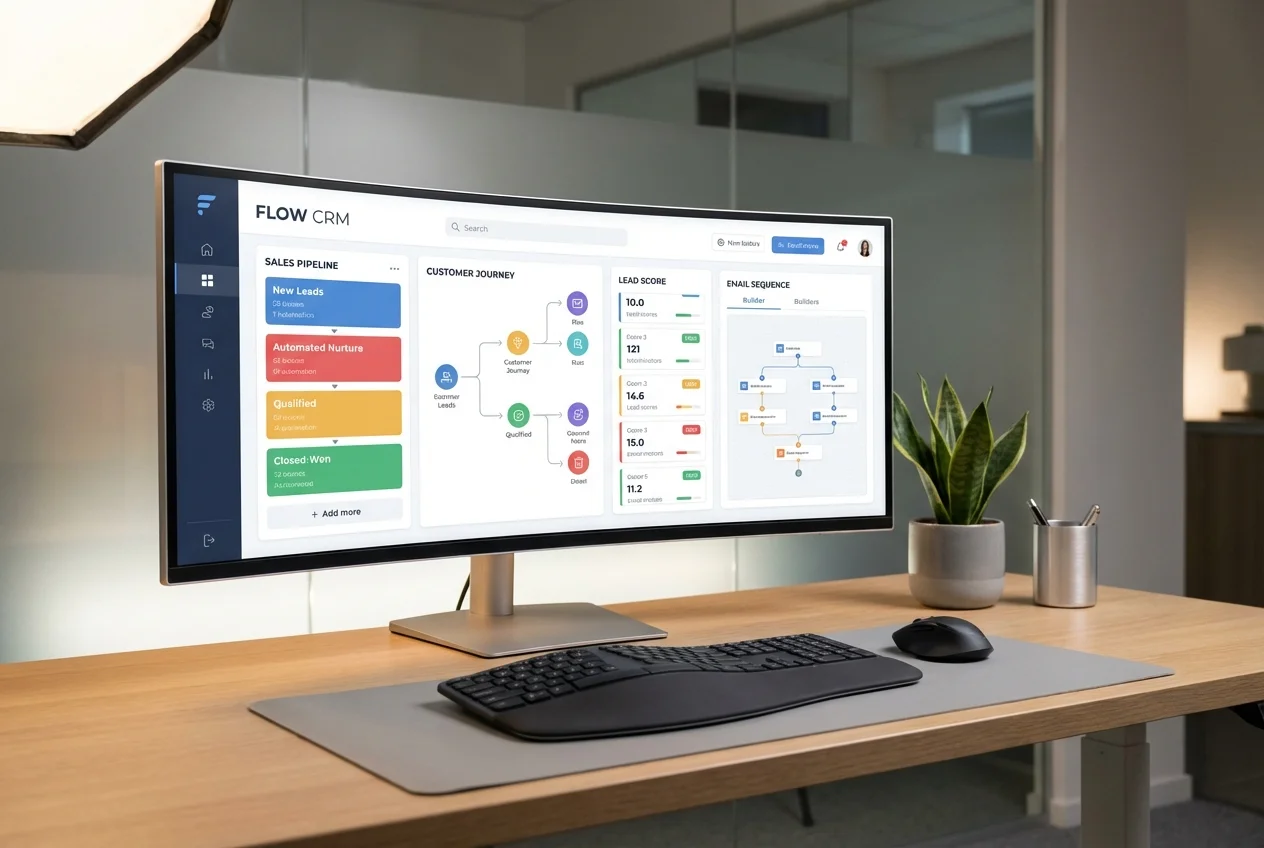
- Qualify inbound leads automatically based on the content of their enquiry
- Personalise follow-up emails based on CRM data without manual drafting
- Analyse competitor mentions and sentiment from social media
- Generate first drafts of proposals using information from the CRM
Operations
- Extract and validate data from invoices, contracts, and forms in variable formats
- Route support tickets to the right team based on content and sentiment
- Generate compliance reports automatically from operational data
- Monitor incoming communications and surface urgent items that need attention
Customer Service
- Answer common queries 24/7 in natural language via a chatbot
- Detect frustrated customers and escalate them before the situation worsens
- Summarise long email threads for agents who are picking up a conversation mid-way
- Translate customer queries into your team's working language automatically
What AI Automation Can't Do
It's important to be honest about the limitations:
- It doesn't replace strategic thinking. AI automation handles operational execution, not business strategy.
- It can make mistakes. AI models can produce plausible-sounding but incorrect outputs. For high-stakes decisions, human oversight remains important.
- It needs maintenance. As your business changes, your automations need to be updated. Set-and-forget doesn't work indefinitely.
- It works best on well-defined problems. The vaguer the task, the harder it is to automate reliably.
AI Automation vs Traditional Automation in Plain English
Traditional automation tools — Zapier, basic Make scenarios, classic CRM rules — execute predetermined branches based on structured triggers. They work brilliantly for predictable, machine-readable inputs ("when invoice arrives in folder, post to Xero"). They fail the moment the input requires interpretation. AI automation replaces those rigid branches with a language model that reads the input, understands intent, and chooses the right action. A traditional automation can route a "new lead" form to a salesperson. AI automation can read a free-text email enquiry, extract the underlying need, score the lead against your ideal customer profile, draft a personalised reply, log structured fields back to your CRM, and notify the right rep — all without anyone touching a keyboard.
The practical implication for UK businesses: traditional automation reaches maybe 20% of your operational work. AI automation reaches the other 80%. For a structured breakdown of services included in a typical engagement, see our AI automation services guide. The most advanced end of this spectrum is agentic AI workflow automation, where the agent doesn't just choose a predefined action — it decides the action itself, case by case.
The Most Common AI Automation Use Cases for UK Businesses
The five workloads that pay back fastest in UK SME and mid-market deployments: inbound lead handling and CRM hygiene (covered by our CRM automation service); document and back-office processing (invoices, contracts, claims); customer service triage and resolution (covered by our AI chatbots service); proposal and quote generation; and continuous data pipelines with anomaly detection (covered by our data pipeline automation service). For a deep dive into how to model the ROI on any of these, read our measuring AI automation ROI guide.
Choosing an AI Automation Agency in the UK
The UK market is now full of firms that added "AI" to their name in the last 18 months. The signal markers of a serious AI automation agency: in-house UK-based engineers, demonstrable production deployments with real AI decision-making, transparent pricing with clearly scoped phases, UK GDPR compliance built in from day one, structured error handling and observability as standard, and a maintenance model that keeps the system evolving with your business. Read our guide to choosing an AI automation agency in the UK and our AI agency UK partner guide for the questions that surface a credible partner.
Where to Start
The best starting point is a specific, painful process — something your team finds tedious, error-prone, or time-consuming. Map that process in detail, identify the parts that require judgement (good candidates for AI) and the parts that are purely mechanical (good candidates for traditional automation), and start there.
You don't need to transform your entire operation on day one. One well-built automation that saves your team two hours a day is more valuable than five half-built ones that break regularly.
If you'd like help identifying your best starting point, we offer a free consultation where we'll work through your processes and give you honest advice about what's possible.
 Agentic Workflow Automation
 Sales & CRM Agents
 Lifecycle & Outreach Agents